Legal Notice vs Court Summons vs Court Order: What Is the Difference? (2026)
Receiving a legal notice, court summons, or court order can be confusing, especially when all three documents appear to demand some action. However, they are not the same thing.
The biggest difference is who issued the document, why it was issued, and what legal effect it has.
A legal notice is generally a formal communication from a person, lawyer, company, or organisation. A court summons is issued through a court process to require a person to appear or respond. A court order is a direction or decision made by a court.
Understanding the difference can help you decide what to do next and avoid ignoring an important deadline.
Legal Notice vs Court Summons vs Court Order: Quick Comparison
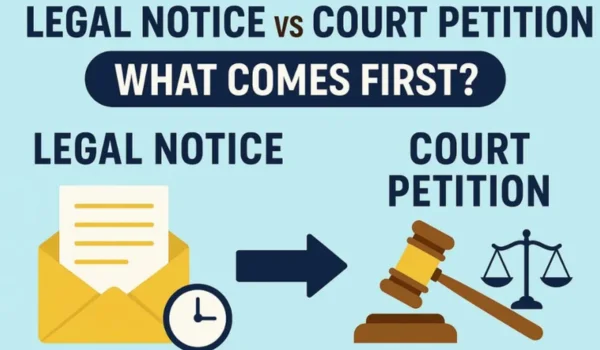
| Point | Legal Notice | Court Summons | Court Order |
| Usually issued by | Individual, lawyer, company or organisation | Court | Court |
| Main purpose | Communicate a legal claim or demand | Require appearance or response | Give a judicial direction/decision |
| Does it mean a case is pending? | Not necessarily | Usually connected to court proceedings | Yes, generally arises from proceedings |
| Is it a court document? | Usually no | Yes | Yes |
| Can it require action? | Yes, depending on circumstances | Yes | Yes |
| Can it contain a deadline? | Yes | Yes | Yes |
| Can ignoring it create legal consequences? | Potentially | Yes | Yes |
| Should you verify authenticity? | Yes | Yes | Yes |
| Best response | Review and respond appropriately | Follow court instructions | Comply, challenge or seek appropriate remedy |
What Is a Legal Notice?
A legal notice is a formal communication informing another person or organisation about a legal grievance, demand, dispute, or proposed legal action.
For example, a person may send a notice demanding:
- Payment of an outstanding amount
- Performance of a contractual obligation
- Compensation for alleged loss
- Return of property
- Stopping certain conduct
- Compliance with an agreement
- Resolution of a dispute before litigation
A lawyer may send the notice on behalf of their client.
Important Point
A legal notice is not automatically a court order.
Receiving one does not necessarily mean that a court has already ruled against you.
Example of a Legal Notice
Suppose a business claims that another company has failed to pay:
₹5 lakh
The business may send a legal notice stating that the amount should be paid within a specified period, failing which it may take legal action.
At this stage, the notice is essentially communicating the claimant’s position and intended action.
The recipient may:
- Pay the amount
- Negotiate
- Dispute the claim
- Send a reply
- Seek legal advice
- Take another appropriate legal step
The correct response depends on the facts and the type of dispute.
What Is a Court Summons?
A court summons is part of a formal judicial proceeding.
It is generally issued through the court process to notify a person that they are required to:
- Appear before the court
- Respond to a case
- File a response
- Produce something
- Take another specified procedural step
A summons should not be treated like an ordinary lawyer’s letter.
It indicates that the matter has entered the court process.
Example of a Court Summons
Suppose a person files a civil case against another person.
If the court directs that the defendant be served with summons, the defendant may receive a document informing them about the proceedings and requiring them to appear or respond according to the court’s directions.
The summons may contain information such as:
- Court name
- Case number
- Parties
- Date
- Time
- Place or mode of appearance
- Nature of proceedings
- Required action
The exact contents depend on the type of proceeding and applicable procedural law.
What Is a Court Order?
A court order is a direction or decision issued by a court.
It can deal with different stages of a case.
For example, a court may issue an order concerning:
- Interim relief
- Injunction
- Payment
- Disclosure of documents
- Appearance
- Filing of pleadings
- Bail or other criminal procedure
- Property
- Case scheduling
- Final determination of a dispute
Not every court order is a final judgment.
Court Order vs Judgment
These terms are sometimes used interchangeably in everyday conversation, but they can have different legal meanings.
A judgment generally explains the court’s determination and reasoning in a matter.
An order is a formal direction of the court.
Depending on the case, a judgment may be followed by a formal decree or order.
Therefore, receiving a court order does not necessarily mean the entire case has ended.
The Biggest Difference
A simple way to remember the three is:
Legal Notice
“I am formally telling you about my legal claim or demand.”
Court Summons
“The court requires you to appear or respond in this proceeding.”
Court Order
“The court has issued a formal direction or decision.”
This distinction is useful, but the exact legal effect depends on the type of proceeding and the document itself.
Does a Legal Notice Mean You Have Been Sued?
Not necessarily.
A legal notice can be sent before a lawsuit or other formal proceeding begins.
For example:
Dispute → Legal Notice → Negotiation → Possible Litigation
But some disputes may proceed through other mechanisms, and certain legal provisions may require or contemplate notice before particular proceedings.
So you should not assume that every legal notice means a lawsuit has already been filed.
Does a Court Summons Mean You Lost the Case?
No.
A summons generally means that you have been brought into or notified of a proceeding and are required to respond or appear.
It does not by itself mean that the court has decided against you.
You may still have an opportunity to:
- Present your defence
- File a response
- Produce evidence
- Contest the allegations
- Raise legal objections
- Seek appropriate relief
The exact procedure depends on the type of case.
Does a Court Order Mean the Case Is Over?
Not necessarily.
Courts issue orders throughout proceedings.
For example, a court might issue an interim order while the main dispute is still pending.
A later order may modify, continue, or cancel an earlier direction.
Therefore, always read the document carefully to determine whether it is:
- Interim
- Procedural
- Final
- Appealable
- Subject to another hearing
Legal Notice vs Summons: Key Difference
| Question | Legal Notice | Court Summons |
| Issued by court? | Usually no | Yes |
| Court case necessarily filed? | No | Generally connected to a proceeding |
| Main purpose | Demand/communication | Notify and require response/appearance |
| Can be replied to? | Yes | Yes, according to procedure |
| Can you ignore it? | Risky | Very risky |
| Does it decide the dispute? | No | No |
A legal notice generally represents the sender’s position.
A summons is part of the court’s formal process.
Summons vs Court Order
These are also different.
Summons
Primarily tells you that you need to appear or respond.
Order
Tells you what the court has directed or decided.
For example:
A summons may require you to appear on a particular date.
An order may state:
The court directs a party to file a response within a specified period.
Can a Legal Notice Be Ignored?
It is generally a bad idea to ignore a legal notice simply because it is not a court document.
Ignoring it may sometimes result in:
- Litigation
- Additional costs
- Loss of an opportunity to resolve the dispute
- Procedural consequences depending on the matter
- Further legal action
However, receiving a notice does not automatically mean that every allegation in it is legally correct.
You should first understand what is being alleged and what legal provision or contractual term is being relied upon.
Can a Court Summons Be Ignored?
You should not casually ignore a court summons.
Depending on the proceeding and applicable law, failure to appear or respond can have serious consequences.
For example, a court may proceed further in your absence in circumstances permitted by law.
The exact consequences vary between civil, criminal, commercial, family, consumer and other proceedings.
If you receive a summons, check:
- Court name
- Case number
- Parties
- Hearing date
- Required response
- Whether personal appearance is required
- Whether a lawyer can appear on your behalf
- Any filing deadline
Can a Court Order Be Ignored?
A court order should be taken extremely seriously.
If you believe an order is incorrect, the appropriate approach is generally to consider the legal remedy available, such as:
- Appeal
- Review
- Revision
- Modification
- Stay application
- Other appropriate proceeding
The available remedy depends on the nature of the order, the court that issued it, and the applicable law.
Simply ignoring the order can create additional legal problems.
How to Check Whether a Court Document Is Genuine
If you receive a document claiming to be from a court, don’t rely solely on a phone number or email address printed on it.
Check details such as:
- Court name
- Case number
- Party names
- Date
- Order/summons details
- Court website or official case-status system
- Advocate details, where applicable
- Digital signatures or verification information, where applicable
India’s official eCourts system provides case-related information and services for many courts. https://services.ecourts.gov.in/
If something appears suspicious, independently verify it rather than using contact details supplied by a potentially fraudulent message.
What Should You Do After Receiving a Legal Notice?
Step 1: Read the entire notice
Don’t react only to the first page or headline.
Step 2: Identify the allegation
Understand exactly what the sender says you did or failed to do.
Step 3: Check the deadline
Some notices ask for a response within a specific period.
Step 4: Collect documents
Keep:
- Contracts
- Invoices
- Emails
- Messages
- Payment records
- Receipts
- Agreements
- Relevant correspondence
Step 5: Don’t make unnecessary admissions
Avoid sending an emotional or careless response.
Step 6: Consider legal advice
For significant disputes, have a lawyer review the notice before responding.
What Should You Do After Receiving a Court Summons?
Treat it as a higher-priority matter.
Check:
Case number → Court → Hearing date → Required response → Appearance requirements
Then obtain the case documents and understand what has actually been filed against you.
If necessary, engage an advocate who handles that type of proceeding.
What Should You Do After Receiving a Court Order?
First determine:
What exactly has the court ordered?
Then check:
- Effective date
- Compliance deadline
- Whether it is interim or final
- Whether there is a stay
- Whether an appeal/review/revision is available
- Whether immediate compliance is required
Do not assume that you can simply wait because you disagree with the order.
Legal Notice vs Court Summons vs Court Order: Real-World Example
Imagine a landlord claims that a tenant owes rent.
Stage 1 — Legal Notice
The landlord sends a notice demanding payment.
This is a formal demand.
Stage 2 — Court Proceedings
If the dispute proceeds to court, the tenant may receive a summons requiring them to respond or appear.
Stage 3 — Court Order
The court may later issue an order concerning the dispute.
The three documents therefore represent different stages or functions:
Demand → Court process → Judicial direction
However, actual proceedings do not always follow this exact sequence.
Common Mistakes to Avoid
Mistake 1: Treating a Legal Notice Like a Court Order
A legal notice is not automatically a judicial decision.
Mistake 2: Ignoring a Summons
A summons is part of formal court proceedings and should be dealt with promptly.
Mistake 3: Assuming a Summons Means You Lost
A summons does not itself decide the case.
Mistake 4: Ignoring a Court Order Because You Disagree
If you disagree, explore the legally available remedy.
Mistake 5: Paying Immediately Without Checking the Claim
A demand in a legal notice is an allegation or claim, not necessarily an established liability.
Mistake 6: Missing Deadlines
Deadlines can be extremely important in legal proceedings.
Mistake 7: Assuming Every WhatsApp/Email Notice Is Genuine
Verify the source, particularly when money or personal information is being demanded.
What If You Receive All Three?
Sometimes a dispute can involve all three at different points.
For example:
Legal Notice
↓
Court Case
↓
Summons
↓
Court Hearing
↓
Court Order
But this is only a simplified example. The exact process depends on the type of dispute and applicable procedural law.
Frequently Asked Questions
Is a legal notice the same as a court summons?
No. A legal notice is generally a formal communication or demand from a party or their lawyer. A court summons is part of a formal judicial proceeding and is issued through the court process.
Is a legal notice legally binding?
A legal notice can have legal significance, but it is not itself a court judgment or order. Its effect depends on the nature of the notice and the applicable law.
Does receiving a summons mean I am guilty?
No. A summons generally notifies you of proceedings and requires an appearance or response. It does not itself establish guilt or liability.
What happens if I don’t respond to a legal notice?
The sender may decide to pursue further legal action. The consequences depend on the dispute and applicable law.
What happens if I don’t appear after receiving a summons?
Potential consequences depend on the type of proceeding and applicable procedural law. In some circumstances, the court can proceed without the person’s presence or take other permitted steps.
Can a court order be challenged?
Potentially, yes. Depending on the type of order and court, possible remedies can include appeal, review, revision, modification or other proceedings. The appropriate remedy should be determined from the specific order and applicable law.
Final Takeaway
The easiest way to understand the difference is:
| Document | Simple Meaning |
| Legal Notice | A formal legal claim, demand or warning |
| Court Summons | Formal notification requiring you to appear or respond in a court proceeding |
| Court Order | A direction or decision issued by a court |
So, a legal notice is not the same as being ordered by a court. A summons indicates that a matter has entered the formal judicial process, while a court order represents an actual direction or decision from the court.
If you receive any of these documents, the safest approach is to verify its authenticity, identify the deadline, preserve relevant documents, and obtain qualified legal advice where the matter is significant or time-sensitive.
You may also like
Leave a Reply