Agreement vs Contract: What Makes a Document Legally Enforceable? (2026)
The words agreement and contract are often used interchangeably, but they do not always mean the same thing in law.
In simple terms, an agreement is a broader concept. A contract is an agreement that is legally enforceable.
This distinction is important when dealing with business deals, employment arrangements, property transactions, loans, service agreements, and everyday commercial transactions.
In India, the primary legislation governing contracts is the Indian Contract Act, 1872, subject to other applicable laws and the specific nature of the transaction.
Agreement vs Contract: Quick Comparison
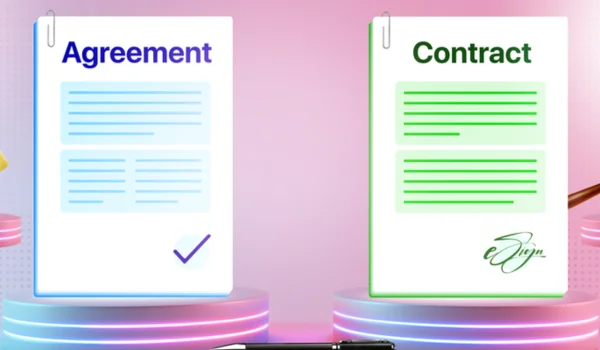
| Point | Agreement | Contract |
| Basic meaning | A promise or set of promises between parties | An agreement enforceable by law |
| Always legally enforceable? | No | Yes, subject to applicable law |
| Requires mutual understanding? | Generally yes | Yes |
| Consideration | Not always required for every agreement | Generally required, subject to statutory exceptions |
| Legal remedy for breach | Not necessarily | Generally available if legally enforceable |
| Example | Friends agree to meet for dinner | Business agrees to provide services for ₹50,000 |
| Governed by contract law? | Depending on nature | Yes, along with other applicable laws |
What Is an Agreement?
Under the Indian Contract Act, an agreement is broadly formed when promises or sets of promises form the consideration for each other.
In everyday language, an agreement simply means that two or more people have reached an understanding.
For example:
A agrees to sell a laptop to B for ₹40,000.
If the necessary legal requirements are satisfied, this agreement may become a contract.
But not every agreement is legally enforceable.
What Is a Contract?
Section 2(h) of the Indian Contract Act, 1872 defines a contract as:
“an agreement enforceable by law.”
This gives us the basic relationship:
Agreement + Legal enforceability = Contract
So, every contract is an agreement, but every agreement is not necessarily a contract.
Simple Example
Imagine two friends agree:
“I will buy you dinner next Friday.”
This is an agreement in the ordinary sense, but it is not normally a legally enforceable commercial contract.
Now consider:
A agrees to supply 1,000 units of a product to B for ₹2 lakh.
If the legal requirements are satisfied, this may constitute a contract.
The key difference is legal enforceability.
What Makes an Agreement a Valid Contract?
Section 10 of the Indian Contract Act sets out important requirements for agreements to become contracts.
Broadly, a legally enforceable contract requires elements such as:
- Offer and acceptance
- Competent parties
- Free consent
- Lawful consideration
- Lawful object
- The agreement must not be expressly declared void
- Compliance with any other legal requirements applicable to the transaction
Some contracts may also need to satisfy additional requirements under other laws.
- Offer
A contract generally begins with an offer or proposal.
An offer is a clear indication that one party is willing to enter into a particular arrangement on specified terms.
Example
A tells B:
“I will sell you my car for ₹6 lakh.”
This can constitute a proposal if the legal requirements are satisfied.
The offer should be sufficiently clear to allow the parties to understand what is being proposed.
- Acceptance
The other party must accept the proposal.
For example:
B says, “I accept your offer of ₹6 lakh.”
Acceptance generally needs to correspond with the terms of the offer.
If B instead says:
“I’ll buy it for ₹5 lakh.”
that may be a counter-offer, rather than acceptance of A’s original offer.
- Consideration
Consideration is essentially the value exchanged between the parties.
For example:
A provides services → B pays ₹50,000
The services and payment form part of the consideration.
Under Indian contract law, consideration is generally required, although Section 25 contains specific exceptions where an agreement without consideration can still be valid.
- Lawful Object
The purpose of the contract must be lawful.
An agreement to perform an illegal act cannot become a legally enforceable contract merely because both parties signed a document.
For example, an agreement to carry out an unlawful activity cannot be made valid by putting it into writing.
- Competent Parties
The parties must have the legal capacity to enter into the contract.
Section 11 of the Indian Contract Act deals with competency to contract.
Generally, a person must:
- Be of the age of majority applicable under law
- Be of sound mind for contracting
- Not be disqualified from contracting by applicable law
- Free Consent
The parties must genuinely consent to the agreement.
Consent may become legally problematic if it was obtained through factors such as:
- Coercion
- Undue influence
- Fraud
- Misrepresentation
- Certain forms of mistake
For example, if someone signs an agreement because of unlawful pressure, questions may arise about whether genuine free consent existed.
- The Agreement Must Not Be Void
Certain agreements are specifically treated as void under the law.
For example, agreements involving unlawful objects or certain restraints may be unenforceable.
Therefore:
“Both parties signed it” does not automatically mean “the contract is valid.”
Is a Written Agreement Necessary?
Not always.
Indian contract law does not require every contract to be written.
A contract can potentially arise through:
- Written agreement
- Oral agreement
- Electronic communication
- Conduct of the parties
However, some transactions are subject to specific statutory requirements regarding writing, registration, stamping, signatures or other formalities.
For important transactions, having a properly drafted written document is generally much safer.
Is a Signed Document Automatically a Contract?
No.
A signature is important evidence of acceptance or execution, but signing alone does not cure every legal defect.
For example, a signed document could still face problems if:
- The object is unlawful
- Consent was obtained through fraud
- A party lacked legal capacity
- The agreement is void under law
- Required statutory formalities were not followed
- The terms are legally unenforceable
The document must be considered as a whole.
Electronic Contracts and E-Signatures
Contracts can also be formed electronically.
Examples include:
- Online service agreements
- E-commerce transactions
- Email agreements
- Digitally signed documents
- Click-wrap agreements
- Electronic business contracts
The Information Technology Act, 2000 gives legal recognition to electronic records and electronic signatures in specified circumstances.
However, electronic execution does not override other legal requirements that may apply to a particular transaction.
Agreement vs Contract: Examples
| Situation | Agreement or Contract? |
| Friends agree to meet for lunch | Usually only a social agreement |
| Business agrees to supply goods for payment | Potentially a contract |
| Two parties agree to perform an illegal act | Not legally enforceable |
| Employer and employee sign a valid employment arrangement | Generally a contract |
| Person promises a gift without consideration | Depends on applicable statutory exceptions |
| Online purchase accepted and paid for | Can create contractual obligations |
Agreement vs Contract in Business
The distinction becomes particularly important for businesses.
Suppose a manufacturer agrees to supply:
10,000 units at ₹100 per unit
The document should clearly identify:
- Product
- Quantity
- Price
- Payment terms
- Delivery date
- Quality standards
- Warranty
- Cancellation terms
- Liability
- Dispute resolution
- Governing law
A vague document can create disputes even when both parties intended to enter into a business arrangement.
What Makes a Contract Easier to Enforce?
A well-drafted contract should clearly establish:
Parties
Full legal names and relevant identification details.
Obligations
What exactly must each party do?
Consideration
How much will be paid and when?
Time
When does performance begin and end?
Conditions
What happens if certain events occur?
Breach
What happens if one party fails to perform?
Termination
When can the contract be ended?
Dispute Resolution
How will disputes be handled?
Signatures/Execution
How will the parties formally execute the document?
These details reduce ambiguity.
Importance of Clear Contract Terms
Consider two clauses.
Weak wording:
“Payment will be made soon.”
Better wording:
“The buyer shall pay ₹2,00,000 within 15 days from the date of delivery.”
The second clause creates a much clearer obligation.
Good contracts reduce uncertainty by answering:
Who? What? When? How much? How? What happens if something goes wrong?
What Happens If One Party Breaches a Contract?
A breach occurs when a party fails to perform an obligation as required by the contract or applicable law.
Depending on the circumstances, the affected party may have remedies such as:
- Damages
- Specific performance where legally available
- Injunction
- Termination
- Other contractual or statutory remedies
The appropriate remedy depends on the nature of the breach and applicable law.
Example of Contract Breach
Suppose A agrees to deliver 1,000 products to B by:
June 30
B has already made the required payment.
A does not deliver the products without a valid contractual reason.
Depending on the contract and applicable law, B may have legal remedies.
The exact remedy could depend on:
- Contract terms
- Nature of goods
- Loss suffered
- Conduct of both parties
- Applicable legislation
Can a Verbal Agreement Be Enforced?
Sometimes, yes.
A verbal agreement can potentially be legally enforceable if the necessary elements of a contract are present and there is no legal requirement for a written or formally executed document.
The difficulty is often proof.
Imagine:
A says:
“We agreed on ₹5 lakh.”
B says:
“No, we agreed on ₹3 lakh.”
Without written records, proving the exact terms can become difficult.
That is why written contracts are strongly preferred for important transactions.
Does WhatsApp Make an Agreement Legally Valid?
A WhatsApp conversation can potentially provide evidence of an agreement.
For example:
“I agree to purchase 500 units at ₹150 each.”
But the complete legal position depends on:
- Offer
- Acceptance
- Consideration
- Intention
- Terms
- Capacity
- Consent
- Other applicable legal requirements
A WhatsApp message should not automatically be treated as a complete contract simply because the word “agree” appears in it.
Stamp Duty and Registration
This is an important distinction.
Contract validity and document formalities are not always the same question.
Certain documents or transactions may require:
- Stamp duty
- Registration
- Specific format
- Witnesses
- Notarisation
- Other statutory formalities
For example, property-related transactions can involve specific requirements under applicable property and registration laws.
Failure to comply with mandatory formalities can affect enforceability or admissibility depending on the circumstances.
Therefore, don’t assume:
“We signed it, so no further formalities are required.”
Contract vs MoU
A Memorandum of Understanding (MoU) is often used to record the understanding between parties.
An MoU is not automatically non-binding, nor is it automatically a legally enforceable contract.
Its legal effect depends on:
- Wording
- Intention of the parties
- Obligations created
- Definiteness of terms
- Applicable law
- Conduct of the parties
Calling a document an “MoU” does not by itself determine whether it is legally enforceable.
Contract vs Agreement vs Memorandum of Understanding
| Document | General Meaning | Automatically Enforceable? |
| Agreement | Understanding between parties | No |
| Contract | Legally enforceable agreement | Generally yes |
| MoU | Records an understanding/intention | Depends on its terms |
The actual contents matter more than the title placed at the top of the document.
Common Mistakes That Can Make Contracts Difficult to Enforce
- Vague Terms
Avoid unclear statements such as:
“Payment will be made later.”
Specify the amount and deadline.
- Missing Party Details
Clearly identify the contracting parties.
- No Termination Clause
Explain when and how the relationship can end.
- Unclear Payment Terms
Mention:
- Amount
- Due date
- Payment method
- Taxes, where relevant
- Late-payment consequences
- No Dispute Clause
Consider specifying how disputes will be resolved.
- Ignoring Applicable Formalities
Check whether stamping, registration or another requirement applies.
- Signing Without Understanding
Never assume that a document is harmless simply because someone says it is “just a formality.”
How to Check Whether a Document Is Legally Enforceable
Before relying on an agreement, ask:
Parties
Who exactly entered into it?
Capacity
Did the parties have legal capacity?
Offer and Acceptance
Was there a clear meeting of minds?
Consideration
What is being exchanged?
Consent
Was consent freely given?
Object
Is the purpose lawful?
Terms
Are the obligations sufficiently clear?
Formalities
Does the transaction require writing, stamping, registration or another formality?
Evidence
Can you prove what was agreed?
Remedies
What happens if one party breaches the agreement?
If several of these questions are unclear, the document should be reviewed before relying on it.
What If a Contract Is Not Written Properly?
That does not automatically mean that there is no legal relationship.
Courts can examine:
- Oral statements
- Emails
- WhatsApp messages
- Invoices
- Payments
- Conduct
- Previous dealings
- Other documents
However, proving the exact terms can become more difficult when there is no clear written contract.
Frequently Asked Questions
Is every agreement a contract?
No. A contract is an agreement that is enforceable by law.
Is every contract an agreement?
Yes. A contract is legally enforceable agreement.
Does a contract have to be signed?
Not necessarily. Depending on the circumstances, a contract can potentially be formed without a formal signature. However, certain transactions have specific legal formalities.
Can an oral contract be legally valid in India?
Yes, potentially, unless applicable law requires the agreement to be in writing or subject to another formality.
Does signing make an agreement legally binding?
Not automatically. Other legal requirements must also be satisfied.
Is an MoU legally binding?
It can be, depending on its wording, the parties’ intention and the applicable law.
Can WhatsApp conversations create a contract?
Potentially, but the complete conversation and all relevant legal requirements need to be considered.
What happens if one party breaches a contract?
The other party may have remedies such as damages, specific performance where available, injunction or termination, depending on the contract and applicable law.
Final Takeaway
The simplest distinction is:
Agreement = Understanding between parties
Contract = Agreement enforceable by law
But signatures alone do not make every document legally enforceable.
A strong contract generally requires clear terms, competent parties, free consent, lawful consideration and lawful purpose, along with compliance with any specific statutory formalities applicable to the transaction.
For important transactions, also check stamp duty, registration, electronic execution and other requirements under the relevant laws.
The Indian Contract Act, 1872 remains the core legislation for general contract principles in India, but other laws can apply depending on the transaction. For a high-value business, property, employment or commercial agreement, professional legal review is advisable before signing.
You may also like
Leave a Reply