Civil Case vs Criminal Case: How the Process Is Different in India (2026)
A civil case and a criminal case are both legal proceedings, but they serve very different purposes.
A civil case generally deals with disputes involving rights, money, property, contracts, compensation, or other private interests. A criminal case concerns an alleged offence against the law, where the state may prosecute the accused.
The procedure, parties, evidence, possible outcomes, and consequences can therefore be very different.
Civil Case vs Criminal Case: Quick Comparison
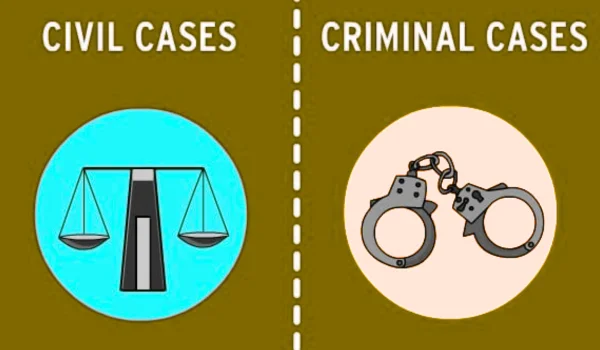
| Point | Civil Case | Criminal Case |
| Main purpose | Resolve a dispute or enforce a legal right | Prosecute an alleged offence |
| Typical parties | Plaintiff vs Defendant | State/Prosecution vs Accused |
| Common examples | Property, contract, money recovery | Theft, assault, cheating, robbery |
| Main question | Who has the legal right or what remedy is due? | Has an offence been committed and has the accused been proved guilty? |
| Possible outcome | Compensation, injunction, declaration, recovery, etc. | Acquittal or conviction and applicable sentence |
| Standard of proof | Generally preponderance of probabilities | Generally beyond reasonable doubt |
| Imprisonment | Generally not the normal remedy | May be imposed where the law provides |
| Settlement | Often possible, subject to the nature of the case | Depends on the offence and applicable law |
| Main procedural framework | Civil procedure and applicable substantive laws | Criminal procedure and applicable criminal laws |
Important: This is a general overview. The exact procedure depends on the type of case, court, offence, applicable statute and facts.
What Is a Civil Case?
A civil case generally involves a dispute concerning private rights and obligations.
Common examples include:
- Property disputes
- Contract disputes
- Money recovery
- Ownership disputes
- Breach of contract
- Certain landlord-tenant disputes
- Injunction matters
- Compensation claims
- Some family and succession disputes
The person bringing the civil claim is commonly called the plaintiff, while the person against whom the claim is brought is commonly called the defendant.
Example of a Civil Case
Suppose A sells goods to B for:
₹5 lakh
B receives the goods but does not make the agreed payment.
A may have a legal claim to recover the amount.
Depending on the circumstances, A may initiate appropriate civil proceedings seeking recovery.
The central question is generally:
Does A have a legally enforceable claim against B, and what remedy should be granted?
This is different from asking whether B committed a criminal offence.
What Is a Criminal Case?
A criminal case concerns an alleged offence under criminal law.
Examples can include allegations involving:
- Theft
- Robbery
- Assault
- Certain forms of cheating
- Criminal breach of trust
- Forgery
- Sexual offences
- Homicide
- Other offences recognised by law
In a criminal prosecution, the State/prosecution generally conducts the case against the accused, although the victim or complainant may have important procedural roles depending on the matter.
The objective is generally to determine whether the accused committed the alleged offence and, if convicted, impose the legally prescribed consequences.
Example of a Criminal Case
Suppose a person is accused of stealing another person’s property.
The matter may be investigated and prosecuted under the applicable criminal law.
The central question becomes:
Has the prosecution proved the accused’s guilt in accordance with the applicable criminal law and required standard of proof?
If guilt is not proved, the accused may be acquitted.
Civil vs Criminal: The Biggest Difference
A simple way to remember it is:
Civil Case
“Who has the legal right, and what remedy should be provided?”
Criminal Case
“Has an offence been committed, and has the accused been proved guilty?”
This distinction is simplified, but it is useful for understanding the basic difference.
Civil Case Process in India
The exact procedure differs between cases, but a typical civil proceeding can look like this:
Dispute
↓
Plaint/Case Filed
↓
Court Examines the Filing
↓
Summons to Defendant
↓
Written Statement/Response
↓
Issues Framed
↓
Evidence
↓
Cross-Examination
↓
Arguments
↓
Judgment
↓
Decree/Order
↓
Appeal or Execution, if applicable
Not every civil case follows exactly this sequence.
Step 1: Filing the Civil Case
A person seeking relief generally initiates the case by filing the appropriate pleadings before the competent court.
The filing generally sets out:
- Facts
- Legal basis
- Cause of action
- Relief requested
- Relevant documents
The court’s jurisdiction must also be considered.
Step 2: Summons to the Defendant
If the case proceeds, the defendant may receive a court summons.
The summons informs the defendant about the proceeding and the need to respond according to the applicable procedure.
This is very different from an ordinary legal notice.
Step 3: Defendant’s Response
The defendant may file the appropriate response, commonly including a written statement in an ordinary civil suit.
The response may:
- Admit allegations
- Deny allegations
- Explain the defendant’s version
- Raise legal objections
- Provide supporting documents
Step 4: Issues Are Determined
The court identifies the important questions that need to be decided.
For example:
Did the defendant breach the contract?
Is the plaintiff entitled to recover the claimed amount?
The issues help determine what evidence is relevant.
Step 5: Evidence
The parties present evidence supporting their respective positions.
Evidence may include:
- Documents
- Contracts
- Emails
- Invoices
- Bank records
- Photographs
- Witness testimony
- Other legally admissible material
Witnesses may be cross-examined.
Step 6: Arguments
After the evidence stage, the parties present their legal arguments.
Their lawyers may explain:
- What facts have been established
- What the applicable law says
- Why the evidence supports their position
- What remedy should be granted
Step 7: Judgment and Decree/Order
The court gives its decision.
Depending on the case, the court may:
- Grant compensation
- Order payment
- Grant or refuse an injunction
- Declare rights
- Dismiss the claim
- Grant another appropriate remedy
In a civil suit, a decree may follow the judgment where applicable.
What Is the Civil Standard of Proof?
Civil cases generally use the preponderance of probabilities standard.
In simple terms, the court considers which version is more probable based on the evidence.
It does not normally require the same level of proof demanded in a criminal prosecution.
Criminal Case Process in India
Criminal proceedings can follow a different path.
A simplified example is:
Alleged Offence
↓
Information/Complaint
↓
Investigation, Where Applicable
↓
Arrest/Bail, Depending on Circumstances
↓
Police Report/Charge-Sheet or Other Appropriate Process
↓
Court Takes Cognisance/Proceedings Continue
↓
Charges, Where Applicable
↓
Prosecution Evidence
↓
Defence Stage
↓
Arguments
↓
Judgment
↓
Acquittal or Conviction
↓
Sentence, If Convicted
Again, the actual process varies significantly depending on the offence and applicable law.
Step 1: Reporting an Alleged Offence
A criminal matter can begin in different ways depending on the offence and circumstances.
For example, information about an alleged cognizable offence may be provided to the police.
Other matters may involve a complaint before a magistrate or another legally prescribed process.
Step 2: Investigation
Where an investigation is required, authorities may:
- Collect evidence
- Question witnesses
- Examine documents
- Inspect locations
- Collect forensic evidence
- Identify suspects
- Take other legally permitted investigative steps
The police investigation and the court’s eventual determination of guilt are separate stages.
Step 3: Arrest and Bail
An accused person may or may not be arrested depending on the circumstances and applicable law.
Being arrested does not mean that the person has been found guilty.
A person accused of an offence is generally entitled to contest the allegations according to law.
Bail rules depend on factors such as:
- Nature of the offence
- Whether the offence is bailable
- Court jurisdiction
- Stage of proceedings
- Specific facts
Step 4: Police Report/Charge-Sheet
After investigation, the police may submit the appropriate report to the court where required.
The exact terminology and procedure depend on the applicable criminal procedural law.
The court then determines how the matter should proceed.
Step 5: Charges
In appropriate cases, the court may frame charges against the accused.
The charges identify the offence or offences the accused is being tried for.
The accused can contest them.
Step 6: Prosecution Evidence
The prosecution presents evidence intended to establish the allegations.
This can include:
- Witness testimony
- Documents
- Forensic evidence
- Digital evidence
- Medical evidence
- CCTV footage
- Other relevant evidence
The defence may cross-examine prosecution witnesses.
Step 7: Defence
The accused gets an opportunity to defend themselves according to the applicable procedure.
The defence may challenge:
- Witness credibility
- Documents
- Investigation
- Identification
- Chain of evidence
- Legal elements of the alleged offence
The accused is not required to prove innocence in the same way that the prosecution is required to prove guilt.
Step 8: Judgment
At the end of the trial, the court determines whether the prosecution has established guilt according to the required legal standard.
The result may be:
Acquittal
The accused is not convicted.
Conviction
The court finds the accused guilty.
If convicted, the court may impose the sentence provided by the applicable law.
Criminal Standard of Proof
Criminal prosecutions generally require proof beyond reasonable doubt.
This is a substantially higher standard than the civil standard of preponderance of probabilities.
It is important to understand that “beyond reasonable doubt” does not mean absolute or mathematical certainty.
Can One Incident Lead to Both Civil and Criminal Cases?
Yes, potentially.
The same underlying events can sometimes give rise to both civil and criminal proceedings.
For example, suppose someone is accused of fraud in connection with a financial transaction.
There could potentially be:
Criminal proceedings
To determine whether a criminal offence was committed.
Civil proceedings
To seek recovery of money or another civil remedy.
The two proceedings can have different purposes and standards of proof.
Example: ₹10 Lakh Financial Dispute
Suppose A gives B:
₹10 lakh
under a business arrangement.
B doesn’t return the money.
Possible Civil Aspect
A may have a claim for recovery of the money, depending on the agreement and facts.
Possible Criminal Aspect
If there is evidence suggesting that B’s conduct constituted a specific criminal offence, criminal proceedings might also arise.
But failure to repay a debt does not automatically make the matter criminal.
The facts and legal ingredients of the alleged offence must be established.
Civil vs Criminal Evidence
Both types of cases rely on evidence, but the legal questions differ.
| Evidence | Civil Case | Criminal Case |
| Contract | Very important in contract disputes | May be relevant in certain offences |
| Bank records | Can establish payments | Can support financial allegations |
| Witnesses | Common | Common |
| CCTV | May establish facts | Can be important evidence |
| Emails/messages | Often relevant | Can be relevant |
| Forensic evidence | Sometimes | Often important in relevant offences |
| Expert evidence | Depending on dispute | Depending on offence |
Whether evidence is admissible and how much weight it carries depends on the applicable law and facts.
Civil Case vs Criminal Case: Possible Outcomes
Civil Case
Possible remedies can include:
- Money recovery
- Compensation/damages
- Injunction
- Declaration
- Specific relief where legally available
- Possession/property-related relief
- Other civil remedies
Criminal Case
Possible outcomes include:
- Acquittal
- Conviction
- Sentence prescribed by law
- Fine
- Imprisonment
- Other legally prescribed consequences
The exact remedy or sentence depends on the applicable law and case.
Can Civil Cases Result in Jail?
Generally, a civil dispute itself does not ordinarily result in imprisonment simply because one party lost the case.
Civil courts generally provide civil remedies such as money recovery, injunctions or declarations.
However, disobeying certain court orders or engaging in conduct amounting to a separate offence can have different consequences.
So don’t assume that every civil court order is consequence-free if ignored.
Can Criminal Cases Result in Compensation?
Yes, depending on the applicable law and circumstances, criminal proceedings can sometimes involve compensation or other relief in addition to criminal consequences.
However, criminal proceedings and civil claims remain conceptually different.
Who Brings the Case?
Civil Case
Usually:
Plaintiff → Defendant
The plaintiff seeks a civil remedy against the defendant.
Criminal Case
Generally:
State/Prosecution → Accused
The prosecution seeks to establish the accused’s guilt.
A complainant or victim may have important roles depending on the nature of the case.
Can a Criminal Case Be Settled?
Sometimes, but not every criminal case can simply be settled privately.
The ability to compromise depends on:
- Nature of the offence
- Applicable law
- Whether the offence is compoundable
- Stage of proceedings
- Court’s powers
- Other relevant circumstances
Serious offences generally cannot be treated like an ordinary private debt dispute.
Can a Civil Case Be Settled?
Many civil disputes can potentially be resolved through:
- Negotiation
- Mediation
- Settlement
- Arbitration where applicable
- Lok Adalat in appropriate matters
The parties may be able to resolve the dispute without a full trial.
Civil Case vs Criminal Case: Time Taken
There is no universal timeline.
A case can take months or years depending on:
- Court workload
- Number of parties
- Complexity
- Evidence
- Number of witnesses
- Interim applications
- Appeals
- Adjournments
- Nature of the dispute
Criminal cases can also vary significantly in duration.
Therefore, be cautious about claims that a particular type of case will always finish within a fixed period.
What Happens If You Lose a Civil Case?
Depending on the judgment, you may have to:
- Pay money
- Comply with an injunction
- Hand over property
- Take or stop a particular action
- Comply with another court direction
If you believe the judgment is wrong, you may have an appellate or other remedy depending on the case.
What Happens If You Are Convicted in a Criminal Case?
The court may impose the punishment provided under the applicable law.
Depending on the offence, this may include:
- Imprisonment
- Fine
- Both
- Other legally prescribed consequences
A conviction may also be challenged through the applicable appellate process.
Civil vs Criminal Case: Which Is More Serious?
It is not useful to say that one is always more serious.
A criminal case can expose an accused person to imprisonment and other criminal consequences.
A civil case can involve substantial financial liability, property rights, business interests, or other significant consequences.
The seriousness depends on the specific circumstances.
Important Change in India’s Criminal Laws
India’s criminal-law framework has undergone major changes.
The Bharatiya Nyaya Sanhita, 2023 (BNS) replaced the Indian Penal Code for offences under the new framework from July 1, 2024.
Similarly, the Bharatiya Nagarik Suraksha Sanhita, 2023 (BNSS) replaced the Code of Criminal Procedure, and the Bharatiya Sakshya Adhiniyam, 2023 (BSA) replaced the Indian Evidence Act, subject to their applicable transitional provisions.
Therefore, older articles referring only to IPC, CrPC and Indian Evidence Act may not accurately describe the current criminal-law framework for every matter in 2026.
For official legislation and current legal text, consult the Government’s India Code portal:https://www.indiacode.nic.in/
A Simple Example to Understand the Difference
Imagine a person damages another person’s property.
Civil Question
Who should pay for the property damage?
The owner may seek compensation through an appropriate civil remedy.
Criminal Question
Did the conduct constitute a criminal offence under applicable law?
If so, criminal proceedings may arise.
The same event can therefore potentially have both civil and criminal consequences, but the legal tests are different.
Common Misunderstandings
“If someone owes me money, it’s automatically a criminal case.”
Not necessarily.
A debt dispute can be civil. Criminal liability depends on whether the facts satisfy the elements of a specific offence.
“If someone is arrested, they are guilty.”
No.
Arrest is not a conviction.
“If I lose a civil case, I will go to jail.”
Generally no.
Civil remedies are normally different from criminal punishment, although separate offences or disobedience of court directions can create additional consequences.
“A criminal complaint automatically means the accused will be convicted.”
No.
The prosecution must establish the case according to the applicable legal standard.
“Civil and criminal cases cannot happen for the same incident.”
They can, depending on the facts and law.
What Should You Do If You Receive Legal Papers?
First identify what you actually received:
Legal Notice?
Court Summons?
Police Notice?
Complaint?
Charge-sheet?
Court Order?
These documents have different legal implications.
Then:
- Check the issuing authority.
- Check the case/reference number.
- Note all deadlines and hearing dates.
- Preserve relevant documents.
- Don’t ignore court communications.
- Consult an appropriate lawyer when the matter is significant.
Frequently Asked Questions
Is a civil case the same as a criminal case?
No. Civil cases generally concern private rights and remedies, while criminal cases concern alleged offences and prosecution under criminal law.
Can one person file both civil and criminal cases?
Potentially, where the same facts give rise to both a civil claim and an offence. Whether both are legally maintainable depends on the circumstances.
Which has a higher burden of proof?
Criminal prosecution generally requires proof beyond reasonable doubt, while civil cases generally apply the preponderance of probabilities standard.
Can a civil case result in compensation?
Yes. Compensation/damages and other civil remedies can be available depending on the claim and applicable law.
Can a criminal case result in imprisonment?
Yes, where the applicable offence carries imprisonment and the accused is convicted.
Can a civil dispute become a criminal case?
A dispute does not become criminal merely because one party calls it fraud or cheating. The facts must satisfy the legal ingredients of a specific criminal offence.
Can a criminal case also involve money recovery?
Potentially, depending on the law and circumstances. Separate civil remedies may also be available.
Final Takeaway
The fundamental difference is purpose:
Civil case → Protect or enforce civil rights and obtain a civil remedy.
Criminal case → Determine whether an offence was committed and whether the accused is guilty.
A civil dispute may involve money, property, contracts or compensation, while a criminal prosecution may involve fine, imprisonment or other criminal consequences.
The two can sometimes arise from the same incident, but they are governed by different procedures and standards of proof.
In simple terms:
Civil law asks: “What legal remedy is owed?”
Criminal law asks: “Has a criminal offence been proved against the accused?”
Because Indian procedural and criminal laws can be fact-specific and have changed significantly since July 2024, anyone dealing with an actual case should rely on the applicable current legislation and qualified legal advice rather than a general article alone.
You may also like
Leave a Reply