Wholesale vs Franchise vs Distribution: Which Business Model Is Better for First-Time Entrepreneurs? (2026)
For a first-time entrepreneur, choosing the right business model can be as important as choosing the right product. Wholesale, franchise and distribution all allow you to build a business around selling products, but their investment requirements, level of control, margins, brand support and risks can be very different.
A franchise may provide a recognised brand and established system, while distribution can offer access to an existing product line and market network. Wholesale generally provides more freedom to select products and suppliers.
So, which model is better for a beginner?
There is no single answer. The better option depends on your available capital, business experience, location, sales ability and willingness to follow a company’s rules.
Wholesale vs Franchise vs Distribution: Quick Comparison
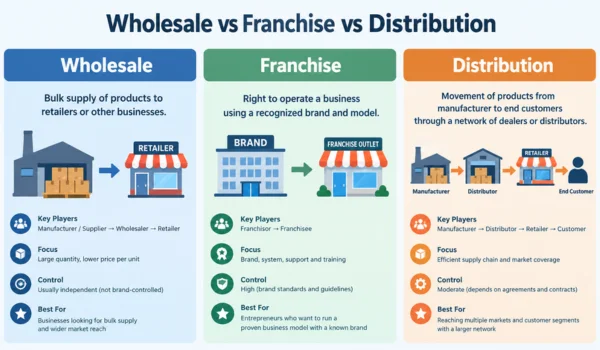
| Factor | Wholesale | Franchise | Distribution |
| Basic Model | Buy and resell products | Operate under an established brand | Supply products to retailers/dealers |
| Brand Dependence | Low | High | Medium to High |
| Initial Investment | Low to Medium | Medium to High | Medium |
| Product Choice | High | Usually Limited | Usually Limited |
| Business Control | High | Moderate | Moderate |
| Brand Support | Usually Low | Usually High | Usually Medium |
| Inventory Requirement | Usually Yes | Depends on model | Usually Yes |
| Marketing Support | Usually Self-managed | Often Available | May be Available |
| Main Skill | Buying & selling | Operations & following systems | Sales & network building |
| Scalability | High | High | High |
| Suitable For | Independent entrepreneurs | Brand-focused operators | Strong sales/network entrepreneurs |
What Is a Wholesale Business?
A wholesale business purchases products in bulk from manufacturers, importers or larger suppliers and sells them to retailers or other businesses.
For example, a wholesaler might purchase stationery in bulk and supply it to several local stationery shops.
Advantages of Wholesale
- Greater freedom to choose suppliers
- Ability to sell multiple brands
- Flexible pricing strategy
- No franchise royalty in the traditional sense
- Easier to change product categories
- Opportunity to build your own customer network
Disadvantages
- You usually have to find suppliers yourself
- Marketing is largely your responsibility
- Inventory can require significant working capital
- Competition can put pressure on margins
- Unsold inventory can become a problem
Wholesale can be attractive for someone who wants maximum control over the business.
What Is a Franchise Business?
A franchise allows an entrepreneur to operate a business using another company’s brand, business model, systems and intellectual property, subject to the terms of a franchise agreement.
Depending on the franchise, the franchisor may provide:
- Brand recognition
- Operating procedures
- Training
- Store design guidelines
- Marketing support
- Product or supplier access
- Technology systems
In return, the franchisee may have to pay an initial fee and potentially ongoing royalties or other charges.
Advantages of Franchise
- Established brand identity
- Structured operating model
- Training may be available
- Marketing support may be available
- Potentially easier customer recognition
Disadvantages
- Higher upfront investment in many cases
- Less freedom in operations
- Franchise fees or royalties may apply
- Brand rules must generally be followed
- Contract terms can restrict certain decisions
- Success still depends heavily on location and execution
A franchise is therefore not simply a “ready-made profitable business.” The franchisee still carries business risks.
What Is a Distribution Business?
A distributor typically purchases products from a manufacturer or company and supplies them to retailers, dealers, businesses or other intermediaries within an assigned market.
For example:
Manufacturer → Distributor → Retailer → Customer
A distributor’s major job is often to build and maintain a sales and distribution network.
Advantages
- Opportunity to work with established products
- Potential for repeat B2B orders
- Can scale by adding retailers and territories
- Strong distribution networks can become valuable business assets
- May receive company support depending on the arrangement
Disadvantages
- Working capital can be significant
- Credit given to retailers can create cash-flow risk
- Sales targets may apply
- Territory conditions may apply
- Dependence on the manufacturer’s products can be substantial
Distribution can be particularly suitable for entrepreneurs who are comfortable with sales, retailer relationships and inventory management.
Wholesale vs Franchise vs Distribution: Investment
Investment varies considerably from one business to another, so there is no universal minimum amount.
However, the structure is different.
Wholesale
Your capital is primarily used for:
- Inventory
- Storage
- Transportation
- Working capital
- Basic infrastructure
Franchise
Your investment may include:
- Franchise fee
- Interior/setup
- Equipment
- Initial inventory
- Security deposit
- Working capital
- Marketing or technology charges
Distribution
Capital may be needed for:
- Initial stock
- Warehouse
- Transportation
- Sales staff
- Working capital
- Security deposits or other company requirements
Important: Do not compare models only on their advertised starting investment. Compare the total capital required until the business becomes operational and cash-flow stable.
Which Model Gives More Business Control?
If control is your priority, the three models generally differ significantly.
Wholesale: Highest Flexibility
You can potentially:
- Change suppliers
- Add products
- Remove weak products
- Negotiate with multiple vendors
- Change your sales strategy
Franchise: Lowest Flexibility
You generally have to follow the franchisor’s:
- Branding
- Store format
- Product/service standards
- Operating procedures
- Marketing guidelines
The exact level of control depends on the franchise agreement.
Distribution: Moderate Flexibility
You have some operational freedom, but your business is still linked to the manufacturer’s:
- Product range
- Pricing policies
- Territory
- Sales targets
- Distribution terms
Which Business Model Has Better Profit Margins?
This is one area where entrepreneurs should be careful.
There is no fixed rule that wholesale, franchise or distribution always produces higher profits.
Your actual profit depends on:
Sales Volume × Contribution Margin − Operating Expenses
A business with a lower margin can potentially generate more total profit if it has much higher sales volume and efficient operations.
For example, a distributor might operate on relatively modest margins but generate substantial revenue through a large retailer network.
A franchise may have stronger brand demand but also have royalties, rent and other operating costs.
A wholesaler may have greater pricing flexibility but face intense competition.
Therefore, compare net profit potential, not just the advertised margin.
Wholesale vs Franchise vs Distribution: Risk Comparison
| Risk | Wholesale | Franchise | Distribution |
| Inventory Risk | High | Medium | High |
| Brand Dependence | Low | High | High |
| Supplier Dependence | Medium | High | High |
| Operating Freedom | High | Low | Medium |
| Customer Acquisition Risk | High | Medium | Medium |
| Contract Risk | Low to Medium | High | Medium to High |
| Cash-Flow Risk | Medium to High | Medium | High |
These are broad business-model characteristics rather than guarantees. The actual risk depends on the contract, product category and business structure.
Which Is Easier for a First-Time Entrepreneur?
It depends on the entrepreneur.
Choose Wholesale If You:
- Want independence
- Know your local market
- Can negotiate with suppliers
- Want to sell multiple brands
- Are comfortable finding customers yourself
Choose Franchise If You:
- Prefer an established business system
- Value brand recognition
- Want structured training/support
- Can follow standardized procedures
- Have enough capital for the complete setup
Choose Distribution If You:
- Have strong local business contacts
- Are good at sales
- Can manage inventory
- Can handle B2B relationships
- Are comfortable managing receivables and working capital
Which Model Is Better With Limited Capital?
For entrepreneurs with limited capital, wholesale or a small service-oriented franchise/distribution opportunity may sometimes be more practical than a capital-intensive franchise.
But don’t assume that wholesale automatically requires less money.
A wholesaler can require substantial working capital because money gets tied up in inventory.
Similarly, a low-entry-cost franchise can have high monthly expenses.
The better question is:
How much total capital will I need to survive until the business generates stable cash flow?
This is much more useful than asking only about the initial investment.
A Simple Decision Framework
Use this framework before choosing your model:
| Your Priority | Model to Consider |
| Maximum independence | Wholesale |
| Established brand | Franchise |
| B2B sales | Distribution |
| Multiple brands | Wholesale |
| Structured business system | Franchise |
| Retailer network building | Distribution |
| Flexible product selection | Wholesale |
| Training and brand support | Franchise |
| Strong sales/networking skills | Distribution |
This is a starting framework, not a guarantee of business success.
What Should First-Time Entrepreneurs Check Before Investing?
Regardless of the model, examine these points before signing an agreement or placing a large inventory order.
For Wholesale
Check:
- Supplier credibility
- Minimum order quantity
- Payment terms
- Product demand
- Return policy
- Competition
- Inventory turnover
For Franchise
Read:
- Franchise agreement
- Initial fees
- Royalty structure
- Territory restrictions
- Renewal conditions
- Exit/termination clauses
- Required suppliers
- Marketing charges
- Estimated operating costs
Do not rely only on sales presentations or projected profit figures.
For Distribution
Check:
- Territory
- Minimum purchase requirements
- Sales targets
- Credit terms
- Retailer margins
- Product expiry/returns
- Security deposits
- Exclusivity conditions
- Manufacturer support
Wholesale vs Franchise vs Distribution: Final Verdict
For a first-time entrepreneur, the best model depends mainly on what you bring to the business.
Wholesale can be better if you want freedom, multiple products and control over supplier selection.
Franchise can be better if you value an established brand, structured systems and training, and you are comfortable operating within contractual rules.
Distribution can be better if you have strong sales ability, local retailer relationships and enough working capital to manage inventory and receivables.
The simplest way to decide:
Want independence? → Wholesale
Want an established brand and system? → Franchise
Want to build a B2B sales network? → Distribution
Before investing, compare the total investment, monthly fixed costs, working-capital requirement, expected contribution margin, sales target, contractual restrictions and exit options. The model that looks cheapest initially is not necessarily the one that is financially safest or most profitable for you.
You may also like


Leave a Reply