FD Laddering in India: How to Build a Monthly Maturity Income Strategy (2026)
A Fixed Deposit (FD) is popular among Indian investors who want predictable returns and relatively stable savings. But putting a large amount into one FD with one maturity date can create a problem: your entire money becomes available at the same time, while you may actually need smaller amounts regularly.
FD laddering solves this by dividing your money across multiple FDs with different maturity dates.
For example, instead of investing ₹6 lakh into one 3-year FD, you could create several deposits that mature at different times. This can provide regular access to money and reduce the need to prematurely break a large FD.
What Is FD Laddering?
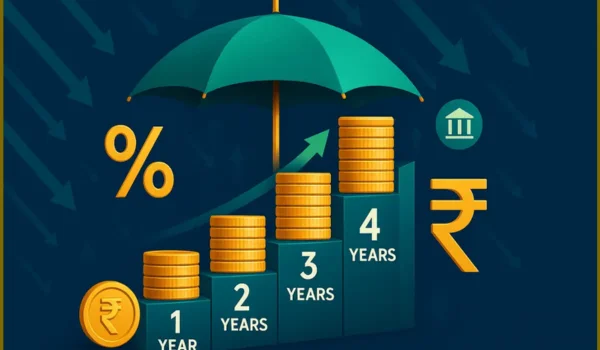
FD laddering means dividing your investment into multiple fixed deposits with different maturity periods.
For example, suppose you have:
₹6 lakh
Instead of:
₹6 lakh → one 3-year FD
you could create:
| FD | Amount | Tenure | Maturity |
| FD 1 | ₹1 lakh | 1 year | Month 12 |
| FD 2 | ₹1 lakh | 1.5 years | Month 18 |
| FD 3 | ₹1 lakh | 2 years | Month 24 |
| FD 4 | ₹1 lakh | 2.5 years | Month 30 |
| FD 5 | ₹1 lakh | 3 years | Month 36 |
| FD 6 | ₹1 lakh | 3.5 years | Month 42 |
The exact FD rates will depend on the bank and date of investment.
The objective isn’t necessarily to find the highest FD rate. It is to create a maturity schedule that matches your cash-flow needs.
Why Use an FD Ladder?
A traditional FD can create a liquidity problem.
Suppose you put:
₹5 lakh → 5-year FD
But after two years you suddenly need ₹1 lakh.
You may have to consider premature withdrawal, subject to the bank’s terms and applicable interest adjustment.
With an FD ladder, you may have an FD maturing around that period, reducing the need to break another deposit.
Main Benefits
- Regular maturity dates
- Better liquidity planning
- Reduced dependence on one FD
- Ability to reinvest gradually
- Easier cash-flow management
- Potential to spread deposits across banks
FD Ladder vs Single FD
| Feature | Single FD | FD Ladder |
| Maturity | One date | Multiple dates |
| Liquidity | Lower between maturity dates | Higher |
| Reinvestment | One major decision | Spread over time |
| Interest-rate exposure | Concentrated | Spread across deposit dates |
| Planning | Simple | Requires more tracking |
| Suitable For | Single future goal | Regular cash-flow needs |
How to Build a Monthly Maturity Strategy
If your goal is to receive an FD maturity every month, you need to create deposits with staggered maturity dates.
Suppose you want:
₹50,000 to mature every month
You could create a ladder of multiple FDs, each designed to mature in a different month.
For example:
| Month | FD Maturity |
| January | ₹50,000 |
| February | ₹50,000 |
| March | ₹50,000 |
| April | ₹50,000 |
| May | ₹50,000 |
| June | ₹50,000 |
| July | ₹50,000 |
| August | ₹50,000 |
| September | ₹50,000 |
| October | ₹50,000 |
| November | ₹50,000 |
| December | ₹50,000 |
This creates a 12-month maturity ladder.
However, the amount required today to create such a ladder will be greater than ₹6 lakh if the ₹50,000 figures represent maturity amounts including interest.
Example: ₹6 Lakh FD Ladder
Suppose you have ₹6 lakh and want to spread it across 12 maturity dates.
A simple starting structure could be:
₹50,000 × 12 = ₹6 lakh
You could create 12 deposits with staggered maturity dates.
However, if your goal is to receive exactly ₹50,000 including interest every month, you need to calculate the principal of each FD based on its tenure and applicable interest rate.
Therefore, the actual deposit amount should be calculated using the bank’s current FD rate.
A Better Strategy: Create the Ladder First
If you already have a large amount available, you can create the ladder immediately.
For example:
₹12 lakh available
You could divide it into:
12 deposits × ₹1 lakh
Then choose different maturity dates.
The first FD might mature after one year, another after 13 months, another after 14 months and so on.
The exact structure depends on whether your objective is:
- Monthly income
- Monthly maturity
- Annual liquidity
- Reinvestment
- Retirement cash flow
FD Laddering for Monthly Income
There is an important difference between:
FD Interest Income
You receive interest periodically according to the FD’s payout option.
FD Maturity Income
You receive the principal plus applicable interest when the FD matures.
If your goal is monthly cash flow, a monthly-interest payout FD may be simpler than creating a monthly maturity ladder.
If your goal is regular access to principal, laddering can be more useful.
Monthly Maturity vs Monthly Interest
| Requirement | Potentially Better Structure |
| Need regular interest income | Monthly interest payout FD |
| Need principal every few months | FD ladder |
| Need annual cash flow | Annual maturity ladder |
| Want reinvestment flexibility | Ladder |
| Don’t need regular liquidity | Single FD may be simpler |
Don’t confuse the two strategies.
A monthly-interest FD can provide periodic interest while the principal remains invested until maturity.
An FD ladder creates multiple maturity dates.
FD Ladder for Retired Investors
An FD ladder can be particularly useful for someone who needs regular liquidity.
Suppose someone wants to cover:
₹30,000 monthly expenses
A ladder can be designed so that deposits mature at intervals that complement other income sources.
But an FD ladder should not automatically replace:
- Pension
- Emergency savings
- Appropriate insurance
- Other investments
The ladder should be part of a broader cash-flow plan.
Example: ₹12 Lakh Ladder
Suppose you have ₹12 lakh and want quarterly access to money.
You could divide the principal into four broad buckets:
| Bucket | Principal |
| FD 1 | ₹3 lakh |
| FD 2 | ₹3 lakh |
| FD 3 | ₹3 lakh |
| FD 4 | ₹3 lakh |
Each could have a different maturity date.
For example:
Month 12 → FD 1
Month 15 → FD 2
Month 18 → FD 3
Month 21 → FD 4
After each maturity, you can decide whether to:
- Use the money
- Reinvest it
- Move it to another FD
- Increase your emergency reserve
What Happens When an FD Matures?
You don’t necessarily have to spend the money.
You have three main choices.
Option 1: Use It
Useful if the maturity was planned for a financial goal.
Option 2: Reinvest It
You can put the proceeds into a new FD.
Option 3: Rebuild the Ladder
You can reinvest the matured FD into a longer-term deposit, moving the ladder forward.
This is sometimes called rolling the ladder.
The Rolling FD Ladder Strategy
Suppose your ladder produces one maturity every quarter.
When the first FD matures, you don’t necessarily need to keep the money idle.
You could reinvest it into a new FD with a longer maturity.
Over time, the ladder continues.
For example:
FD matures → evaluate cash requirement → reinvest surplus → new maturity date
This allows you to maintain a rolling maturity schedule.
What About Changing FD Rates?
This is one of the advantages of laddering.
Suppose FD rates are currently high.
You invest part of your money now.
Later, rates fall.
Because not all your deposits mature at the same time, you aren’t forced to reinvest the entire portfolio at the lower rate on one particular date.
Similarly, if rates rise, upcoming maturities give you opportunities to reinvest at potentially higher rates.
Therefore, laddering can reduce reinvestment timing concentration.
It does not guarantee higher returns.
Don’t Chase the Highest FD Rate Blindly
Suppose:
Bank A FD = 7.0%
Bank B FD = 7.5%
The higher rate may look attractive, but you should also consider:
- Bank type
- Deposit insurance
- Tenure
- Premature withdrawal rules
- Tax treatment
- Senior-citizen rates, if applicable
- Overall financial strength and suitability
DICGC currently insures eligible bank deposits up to ₹5 lakh per depositor per bank, including principal and interest, subject to its rules. Deposits held at different branches of the same bank are aggregated for this limit.
So if you have a large FD portfolio, spreading deposits across banks can be relevant to deposit-insurance planning.
Example of Deposit-Insurance Planning
Suppose you have:
₹10 lakh
in eligible deposits at one bank.
You should not assume that the entire ₹10 lakh is covered by DICGC insurance.
The current maximum insurance coverage is:
₹5 lakh per depositor per bank
for eligible deposits held in the same right and capacity, including principal and accrued interest within the applicable limit.
Deposits with different banks receive the insurance coverage separately, subject to the applicable rules.
This doesn’t mean every investor must split an FD portfolio across banks, but it is an important factor when deciding how to structure a large deposit portfolio.
FD Laddering and Tax
FD interest is generally taxable as income according to the applicable tax rules.
This means you should compare FDs based on post-tax returns, especially if you’re in a higher income-tax bracket.
For example, a quoted FD rate of:
7%
doesn’t necessarily mean you keep 7% after tax.
Your effective return depends on your applicable tax treatment.
Cumulative vs Non-Cumulative FD
When building a ladder, you also need to choose between:
Cumulative FD
Interest is accumulated and paid at maturity.
This can be useful when your objective is to grow the deposit until maturity.
Non-Cumulative FD
Interest is paid periodically according to the selected payout frequency.
This may be more appropriate if you’re using FD interest as regular income.
How Much Money Do You Need for Monthly Maturity Income?
This depends on the maturity amount you want.
Suppose your target is:
₹25,000 every month
Annual requirement:
₹25,000 × 12 = ₹3 lakh
But you cannot simply divide ₹3 lakh by the FD rate to calculate the required corpus.
Why?
Because you’re receiving principal as well as interest through the maturities.
The required corpus depends on:
- FD tenure
- Interest rate
- Whether interest is cumulative
- Tax
- Whether you reinvest matured deposits
- How long you want the strategy to continue
Therefore, a proper ladder calculator should model the actual maturity schedule.
A Simple Monthly Maturity Example
Suppose your target is:
₹30,000 maturity every month
You want a 12-month ladder.
You could initially divide your investment into 12 deposits.
| Deposit | Target Maturity |
| FD 1 | January |
| FD 2 | February |
| FD 3 | March |
| FD 4 | April |
| FD 5 | May |
| FD 6 | June |
| FD 7 | July |
| FD 8 | August |
| FD 9 | September |
| FD 10 | October |
| FD 11 | November |
| FD 12 | December |
Once the ladder is established, each maturity can either be withdrawn or reinvested.
Is FD Laddering Better Than One Large FD?
Not necessarily.
One Large FD May Be Better If:
- You have one specific future goal
- You don’t need periodic liquidity
- You want simplicity
- The maturity date matches your financial goal
Laddering May Be Better If:
- You need periodic liquidity
- You want regular maturity dates
- You want to spread reinvestment decisions
- You don’t want to break a large FD unexpectedly
The strategy should follow the cash-flow requirement, not the other way around.
FD Laddering vs Monthly SIP
These serve completely different purposes.
| FD Ladder | SIP |
| Fixed-income/deposit strategy | Regular investment method |
| Generally lower market risk | Market-linked |
| Predictable maturity structure | No fixed maturity |
| Suitable for planned liquidity | Often used for long-term goals |
| Returns depend on FD terms | Returns depend on underlying investment |
You shouldn’t use an FD ladder simply because you want to avoid all investment risk, nor should you use an equity SIP for money that you know you will need shortly.
Common FD Laddering Mistakes
Making All FDs Mature on the Same Date
That defeats the main purpose of laddering.
Ignoring Tax
The headline FD rate is not necessarily your effective return.
Keeping Everything in One Bank
For large deposits, consider the DICGC insurance framework and concentration risk.
Forgetting Maturity Instructions
Check whether the FD will automatically renew and under what terms.
Using Long Tenures Without Considering Liquidity
You may need the money earlier than expected.
Chasing Small Rate Differences
A slightly higher rate may not compensate for unsuitable tenure, liquidity restrictions or concentration.
A Practical FD Laddering Formula
You can build your ladder using:
Target maturity amount × Number of maturity periods
For example:
Target monthly maturity:
₹50,000
Number of monthly maturities:
12
Basic maturity requirement:
₹50,000 × 12 = ₹6 lakh
You then adjust the required principal for interest earned, tax and the exact FD tenure/rate.
Who Should Consider FD Laddering?
It may be useful for:
- Retirees seeking planned liquidity
- Conservative investors
- People with large cash reserves
- Investors planning future expenses
- Parents funding education over multiple years
- Investors who want staggered reinvestment dates
- People who don’t want all deposits locked until one maturity date
Final Verdict
FD laddering is less about earning the highest FD rate and more about managing liquidity and maturity timing.
Instead of putting all your money into one FD:
Divide → Stagger maturities → Track dates → Use or reinvest each maturity
For example, someone with ₹12 lakh could create a series of deposits that mature at different intervals rather than waiting for one large FD to mature.
For a monthly-income strategy, remember the difference between monthly interest payout and monthly FD maturity. The first provides periodic interest while the principal remains invested; the second creates a series of deposits that become available at different dates.
And for larger portfolios, don’t ignore deposit-insurance rules: DICGC currently covers eligible deposits up to ₹5 lakh per depositor per bank, including principal and interest within the applicable limit.
The best FD ladder is therefore the one that matches your monthly cash-flow needs, investment horizon, tax position and liquidity requirements, rather than simply choosing the FD with the highest advertised interest rate.
You may also like


Leave a Reply