Distributor vs Dealer vs Stockist: Difference, Investment and Profit Potential (2026)
Distributor, dealer and stockist are common terms in India’s wholesale and supply chain business. They are sometimes used interchangeably, but they can represent different roles.
For a new entrepreneur, understanding these differences is important because the investment required, customer type, inventory responsibility, working capital and profit model can vary considerably.
The biggest mistake is to choose a role based only on the advertised margin. A business with a higher margin may still generate less profit if its sales volume is low or its working capital requirement is high.
Quick Comparison
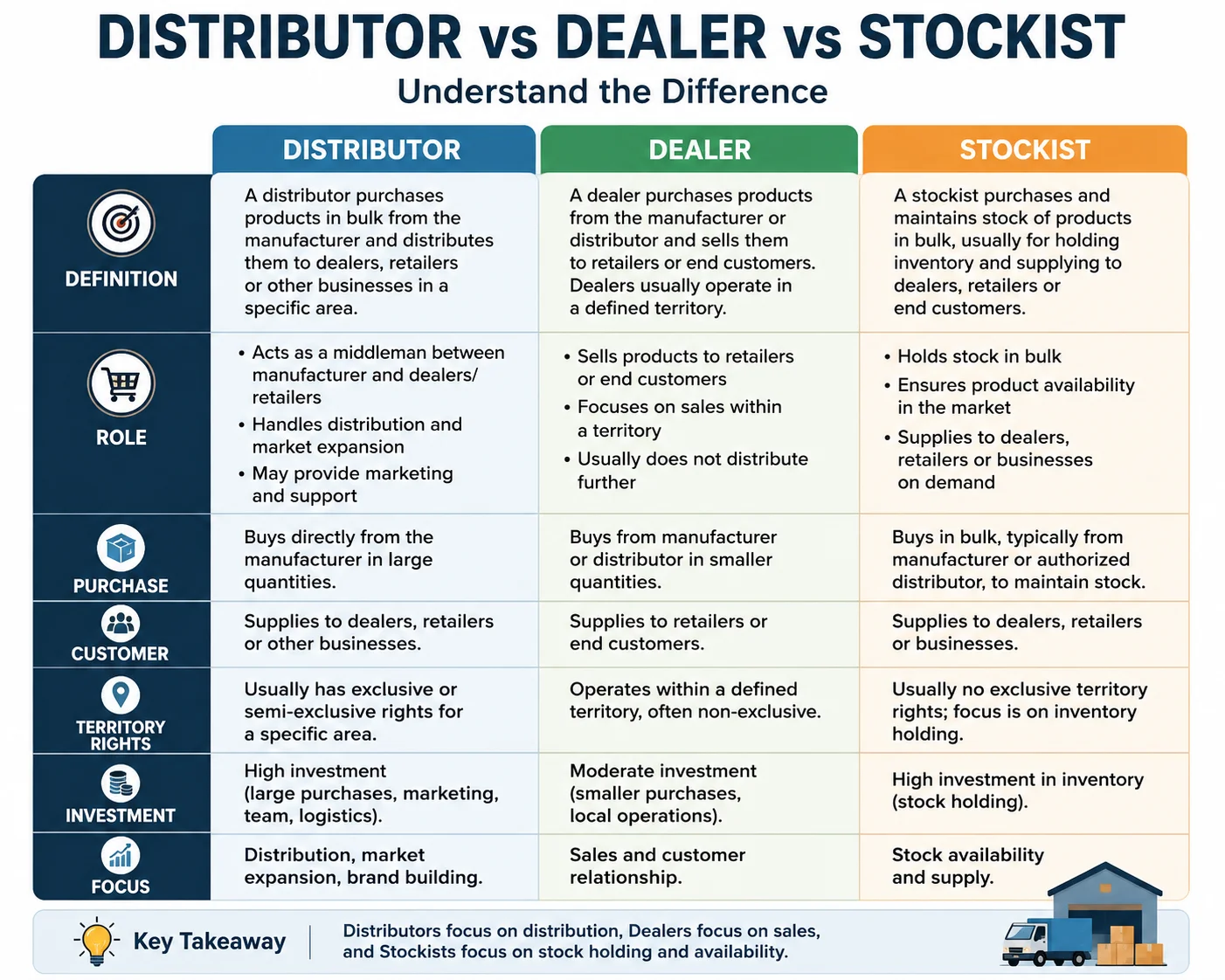
| Factor | Distributor | Dealer | Stockist |
| Main Role | Supplies products to retailers/dealers | Sells products to customers or businesses | Holds and supplies inventory |
| Typical Customers | Retailers, dealers, businesses | End customers or local businesses | Retailers/distributors |
| Inventory | Usually High | Low to Medium/High | High |
| Working Capital | High | Medium | High |
| Sales Focus | Network/B2B | Retail or B2B | Supply & availability |
| Territory | May be assigned | Usually local | May be territory-based |
| Brand Dependence | High | Medium to High | High |
| Main Strength | Distribution network | Customer sales | Inventory availability |
| Main Risk | Credit + inventory | Demand + competition | Inventory + cash flow |
Important: There is no universal legal or industry-wide definition that makes these terms identical across every business. Companies may define distributor, dealer and stockist differently in their agreements.
What Is a Distributor?
A distributor generally purchases products from a manufacturer or principal company and supplies them to a network of retailers, dealers, institutions or other businesses.
A simplified supply chain can look like:
Manufacturer → Distributor → Retailer → Customer
A distributor may be responsible for developing a market, maintaining inventory and ensuring that products reach downstream sellers.
Common Distributor Responsibilities
Depending on the agreement, a distributor may:
- Purchase inventory from the manufacturer
- Maintain stock
- Supply retailers
- Develop a sales network
- Manage local logistics
- Collect payments
- Promote products
- Meet sales targets
Some distribution agreements may also provide territory rights or exclusivity, but this depends entirely on the contract.
What Is a Dealer?
A dealer generally buys products from a manufacturer, distributor or supplier and resells them.
The dealer may sell directly to:
- Consumers
- Businesses
- Contractors
- Institutions
- Retail customers
For example:
Manufacturer → Distributor → Dealer → Customer
However, the exact structure differs by industry.
A dealer’s business is usually more focused on selling products to the next customer rather than primarily maintaining a large distribution network.
Examples
Dealer models are common in industries such as:
- Automobiles
- Construction materials
- Electronics
- Agricultural equipment
- Industrial products
- Machinery
The capital requirement can vary significantly depending on the product.
What Is a Stockist?
A stockist primarily focuses on keeping products available in a particular market or territory.
A simplified model may look like:
Manufacturer/Company → Stockist → Retailers
The stockist maintains inventory so that downstream sellers can obtain products without waiting for direct supply from the manufacturer.
In some industries, stockist and distributor may perform very similar functions.
This is why you should always check the company’s specific agreement rather than relying only on the job title.
Distributor vs Dealer vs Stockist: Main Difference
The easiest way to understand them is to look at their primary business function.
Distributor
Main focus: Moving products through a distribution network.
Dealer
Main focus: Selling products to customers or businesses.
Stockist
Main focus: Maintaining product availability through inventory.
In reality, one company can sometimes perform more than one of these roles.
For example, a business might operate as a distributor while also acting as a stockist and selling directly to selected customers.
Investment Comparison
There is no fixed investment amount for any of these models.
It depends on:
- Product category
- Territory
- Minimum order quantity
- Warehouse requirement
- Credit terms
- Sales targets
- Vehicle requirements
- Product value
- Inventory turnover
- Security deposit
- Company policies
Generally:
Distributor
Often requires medium to high working capital because the business may need substantial inventory and may provide credit to retailers.
Dealer
Can range from relatively low to very high investment.
A small equipment dealer and an automobile dealer, for example, can have completely different capital requirements.
Stockist
Often requires substantial inventory capacity because maintaining product availability is central to the role.
Where Does the Money Actually Go?
Don’t look only at the amount needed to become a distributor or dealer.
Your total investment can include:
| Expense | Distributor | Dealer | Stockist |
| Initial Inventory | High | Medium–High | High |
| Warehouse | Often Required | Depends | Often Required |
| Shop/Showroom | Sometimes | Often | Sometimes |
| Delivery Vehicle | Often Useful | Depends | Often Useful |
| Staff | Medium–High | Low–Medium | Medium |
| Working Capital | High | Medium | High |
| Branding/Setup | Depends | Depends | Depends |
The working-capital requirement can be more important than the initial setup cost.
Profit Potential: How Does It Work?
Profit should be analysed using contribution, not just the stated margin.
A simple calculation is:
Gross Contribution = Sales Revenue − Product Cost
Then:
Operating Profit = Gross Contribution − Operating Expenses
For example, suppose a business sells ₹10 lakh worth of products in a month.
If its effective gross margin is 8%:
₹10,00,000 × 8% = ₹80,000
That ₹80,000 is not automatically the owner’s profit.
You still need to consider:
- Salaries
- Warehouse rent
- Transportation
- Electricity
- Damaged goods
- Bad debts
- Interest/finance costs
- Taxes and applicable charges
- Other operating expenses
The remaining amount is what contributes to actual business profit.
Distributor Profit Potential
Distributors may operate on relatively modest margins while depending on high sales volume.
For example:
Higher volume × Lower margin = Potentially attractive total contribution
A distributor can improve profitability through:
- Higher sales volume
- Better inventory turnover
- Efficient delivery
- Lower operating costs
- Strong retailer relationships
- Reduced credit losses
But high sales do not automatically mean high profit.
If working capital is stuck in slow-moving inventory or unpaid retailer invoices, cash flow can become a serious problem.
Dealer Profit Potential
Dealers can sometimes have greater flexibility in pricing and customer relationships.
Their profitability depends heavily on:
- Product category
- Brand
- Local competition
- Selling price
- Customer demand
- Service income
- Inventory turnover
For some businesses, after-sales service, installation or accessories can contribute significantly to the overall business economics.
Therefore, when evaluating a dealership, examine all revenue streams, not just product margins.
Stockist Profit Potential
A stockist may generate income through the spread between the purchase and selling prices under the applicable commercial arrangement.
But the business can be highly dependent on inventory turnover.
Suppose you have ₹20 lakh of inventory but only a small amount of stock moves every month.
Your nominal margin may look attractive, but capital remains tied up.
This is why stockists should pay close attention to:
Inventory Turnover + Margin + Credit Period + Collection Time
Which Model Requires More Working Capital?
In many cases, distribution and stockist models can require more working capital than a simple dealership because they may involve larger inventories and B2B credit.
However, this is not universal.
An automobile dealership, for example, can require substantially more capital than a small FMCG distributor.
The correct comparison is:
Total Capital Required = Setup Cost + Inventory + Receivables + Operating Buffer
This provides a better picture than simply looking at the initial stock requirement.
Credit Is a Major Risk
One of the biggest issues in B2B distribution is credit sales.
Suppose you sell ₹5 lakh worth of products to retailers but allow them 30–60 days to pay.
Your sales have happened, but your cash may not have arrived.
Meanwhile, you may need money for:
- New inventory
- Salaries
- Transport
- Rent
- Utilities
Therefore:
Profit ≠ Cash Flow
A profitable distribution business can still face financial pressure if customers delay payments.
Distributor vs Dealer vs Stockist: Which Is Easier?
| If You Are Good At… | Model to Consider |
| Building retailer networks | Distributor |
| Direct customer selling | Dealer |
| Inventory management | Stockist |
| B2B sales | Distributor |
| Local retail sales | Dealer |
| Warehouse operations | Stockist |
| Territory development | Distributor |
| Customer relationships | Dealer |
This is only a general guide because company-specific business models vary.
Which Model Is Better for a First-Time Entrepreneur?
Choose Distribution If You:
- Have strong local business contacts
- Can build a retailer network
- Understand B2B sales
- Can manage working capital
- Are comfortable with inventory
Choose Dealership If You:
- Prefer direct customer sales
- Understand the product category
- Can manage a retail operation
- Have a suitable local market
- Can provide required service/support
Choose Stockist Business If You:
- Have access to suitable storage
- Can manage inventory efficiently
- Have sufficient working capital
- Are comfortable with B2B supply
- Can maintain reliable product availability
Questions to Ask Before Taking a Dealership or Distribution
Before signing an agreement, ask the company:
Financial
- What is the initial investment?
- What is the minimum opening stock?
- Is there a security deposit?
- What are the payment terms?
- What margin or incentive structure applies?
- Are there sales targets?
Territory
- What territory will I receive?
- Is the territory exclusive?
- Can the company appoint another distributor nearby?
- Can I sell outside the assigned territory?
Inventory
- What happens to expired or damaged products?
- Can unsold inventory be returned?
- How frequently should stock be replenished?
- What is the expected inventory turnover?
Contract
- How long is the agreement?
- What are the renewal terms?
- What are the termination conditions?
- What happens to remaining stock if the agreement ends?
These questions can prevent unpleasant surprises later.
How to Compare Two Opportunities
Suppose Company A offers a distribution opportunity and Company B offers a dealership.
Don’t simply choose the one offering the higher margin.
Create a comparison like this:
| Metric | Opportunity A | Opportunity B |
| Initial Investment | ₹_____ | ₹_____ |
| Monthly Sales Target | ₹_____ | ₹_____ |
| Gross Margin | ___% | ___% |
| Monthly Operating Cost | ₹_____ | ₹_____ |
| Credit Period | ___ days | ___ days |
| Inventory Requirement | ₹_____ | ₹_____ |
| Expected Collection Period | ___ days | ___ days |
| Estimated Contribution | ₹_____ | ₹_____ |
| Working Capital Needed | ₹_____ | ₹_____ |
This makes the decision much more objective.
Final Verdict
There is no universally “most profitable” option among distributor, dealer and stockist businesses.
Distributor: Best suited to entrepreneurs who can build a strong B2B network and manage inventory and credit.
Dealer: Often suitable for entrepreneurs who want to focus on direct customer sales and local market development.
Stockist: Suitable for entrepreneurs who can manage inventory, storage and working capital efficiently.
Before investing, don’t focus only on the margin or company name. Evaluate the complete economics:
Sales Volume + Margin + Inventory Turnover + Credit Period − Operating Costs = Real Business Potential
A business with a smaller margin but fast inventory movement and quick customer payments can sometimes be financially healthier than one advertising a much higher margin.
You may also like

Leave a Reply